A quick framing note. These stretches are for healthy adults who experience the usual desk-job aches and want to prevent or reduce them. If you have a diagnosed condition — herniated disc, severe arthritis, a recent injury, pregnancy complications, or chronic pain you’ve been seeing a doctor about — talk to your physical therapist or physician before adopting any new stretching routine. The advice below is general; individual situations vary.
Why Sitting All Day Causes Problems
The human body wasn’t designed for eight hours of static seated work. Three specific mechanical patterns develop over time, and most desk-related discomfort traces back to one or more of them.
Shortened hip flexors. The muscles at the front of your hip stay in a contracted position for hours. Over months, they adapt to that shortened length, and standing tall or walking with a full stride becomes restricted. Tight hip flexors are also a major cause of lower back pain, because the pelvis tilts forward to compensate.
Forward head posture and rounded shoulders. Looking at a screen for hours pulls the head forward of the spine and rolls the shoulders inward. The neck and upper back muscles strain to hold this position. Within years, you can develop what people often describe as a “tech neck” — a noticeable forward curve, persistent neck and shoulder tension, and tension headaches that don’t fully respond to medication.
Reduced circulation and stiffness. Blood flow slows when muscles aren’t actively moving. Joints stiffen without movement. The legs, lower back, and even the brain function worse when you’ve been sitting for two-plus hours without changing position. Some research has linked extended sedentary time to elevated risks for cardiovascular disease, type 2 diabetes, and certain cancers, even among people who exercise regularly outside of work.
The good news: these are mechanical, gradual problems with mechanical, gradual solutions. A few minutes of movement and stretching every hour, sustained over months, reverses much of the damage. You don’t need a gym, equipment, or special clothing. You need a chair, a small open area near your desk, and a willingness to look slightly unusual to coworkers for 90 seconds at a time.
The Most Important Habit: Move Often, Not Long
Before specific stretches, the most important habit is simply changing position frequently. A 30-second stretch every 30 minutes is more effective than a 30-minute stretch session at the end of the day. The reason is that the damage of prolonged sitting is cumulative — every hour without movement is another hour of compression, reduced circulation, and muscle shortening. Breaking up that time, even briefly, interrupts the pattern.
A workable target for most desk workers: stand up, walk, or stretch every 30–60 minutes throughout the workday. Set a timer on your phone or use a calendar reminder if you tend to lose track of time. Even a one-minute break to walk to the kitchen or stretch at your chair makes a measurable difference compared to staying seated for three hours straight.
Equally important: vary your work position throughout the day. OSHA’s guidance recommends performing some tasks in standing — reading, phone calls, meetings — to give your seated muscles a break. You don’t need a standing desk to do this. Standing during phone calls, or moving to a counter for ten minutes of reading, achieves the same effect.
Eight Stretches You Can Do Without Leaving Your Desk
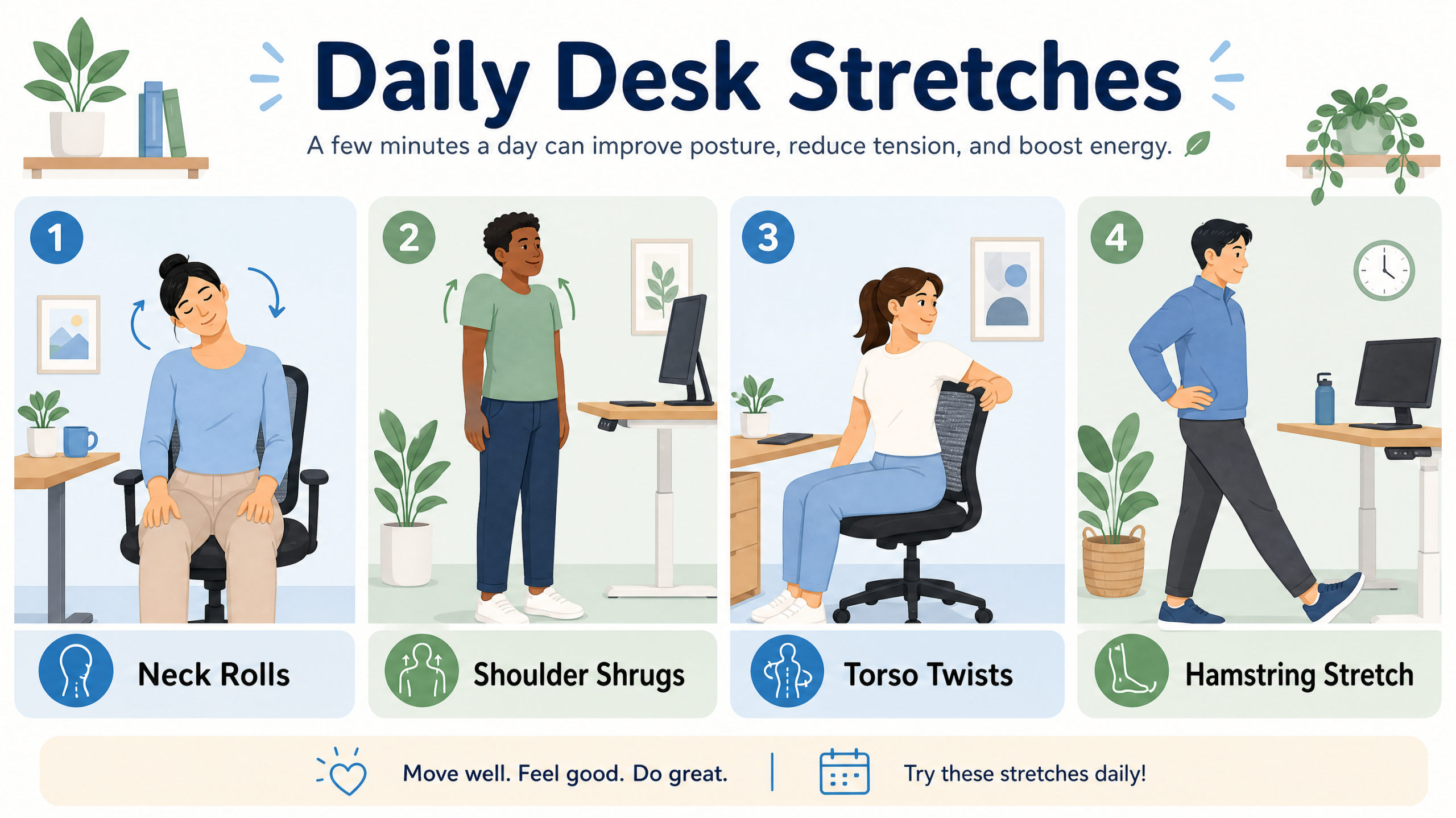
These eight stretches target the specific muscle groups that prolonged sitting compromises. None requires equipment, and most can be done while you’re still on a call or reading email. Hold each stretch for 20–30 seconds unless otherwise noted, and breathe normally throughout — don’t hold your breath.
1. Neck Tilts and Chin Tucks
Target: Tight neck muscles, forward head posture.
How to do it: Sit tall. Slowly tilt your right ear toward your right shoulder until you feel a gentle stretch on the left side of your neck. Hold 20 seconds. Switch sides. Then do chin tucks: gently draw your chin straight back (not down) as if trying to make a double chin, hold 5 seconds, release. Repeat 5–10 times.
Chin tucks specifically counteract forward head posture by re-engaging the deep neck flexors most desk workers have switched off. Among all the stretches in this article, this one has the highest payoff per second of effort.
2. Shoulder Rolls
Target: Rounded shoulders, upper back tension.
How to do it: Lift your shoulders toward your ears, roll them back, down, and forward in a smooth circle. Do 10 slow rolls backward, then 10 forward. Exaggerate the backward portion of the motion to counteract the forward-shoulder pattern.
This stretch can be done discreetly during a video call without anyone noticing. It improves circulation in the upper back and reactivates the muscles that hold your shoulders in proper position.
3. Doorway Chest Stretch
Target: Tight chest, rounded shoulders.
How to do it: Stand in a doorway. Place your forearms on the door frame at shoulder height, elbows at about 90 degrees. Step one foot forward through the doorway, letting your chest open. Hold 20–30 seconds. Adjust your arm height slightly to target different parts of the chest.
The chest muscles tighten dramatically from typing and screen work. Opening them counteracts the rounded-shoulder pattern more directly than almost any other stretch. If you have no doorway available, you can do a seated version by clasping your hands behind your back and gently lifting them while squeezing your shoulder blades together.
4. Seated Spinal Twist
Target: Lower and middle back stiffness.
How to do it: Sit tall with both feet flat on the floor. Place your right hand on the outside of your left knee and your left hand on the back of your chair. Gently rotate your torso to the left, looking over your left shoulder. Hold 20–30 seconds. Switch sides.
This is one of the few stretches that mobilizes the spine itself, not just surrounding muscles. Done twice a day, it noticeably reduces afternoon back stiffness for most desk workers.
5. Seated Figure-4 (Hip Stretch)
Target: Tight hips, glutes, lower back.
How to do it: Sit tall with both feet flat on the floor. Cross your right ankle over your left knee, forming a “4” shape with your legs. Keep your back straight and gently lean forward at the hips until you feel a stretch in your right hip and glute. Hold 30 seconds. Switch sides.
Tight glutes and hips contribute heavily to lower back pain in desk workers. This stretch, done daily, addresses the root cause rather than just the symptom.
6. Standing Hip Flexor Stretch
Target: Shortened hip flexors from prolonged sitting.
How to do it: Stand next to your chair. Step your right foot back into a half-kneeling lunge position (back knee on the floor if comfortable, or stand in a deep split stance). Tuck your tailbone under slightly and press your hips gently forward until you feel a stretch in the front of your right hip. Hold 30 seconds. Switch sides.
The hip flexors are the single muscle group most affected by sitting. Almost everyone with a desk job has tight hip flexors, and almost no one stretches them regularly. Doing this once a day reverses years of sitting damage faster than any other single stretch.
7. Wrist and Forearm Stretches
Target: Forearm tension, wrist stiffness, RSI prevention.
How to do it: Extend your right arm straight in front of you, palm facing down. With your left hand, gently pull your right fingers down and back toward your body. Hold 15 seconds. Flip your right palm up and gently pull the fingers down and back. Hold 15 seconds. Switch arms.
Hours of typing and mouse use create chronic tension in the forearms. This stretch is essential for anyone who’s noticed wrist or forearm discomfort, and prevention is dramatically easier than treating an established repetitive strain injury.
8. Calf Raises and Ankle Circles
Target: Circulation in the legs, ankle stiffness.
How to do it: Stand near your desk. Lift up onto the balls of your feet, then lower. Repeat 15–20 times. Then, while seated, lift one foot off the floor and rotate the ankle in slow circles — 10 in each direction. Switch feet.
Blood pooling in the lower legs is one reason your legs feel heavy after a long day at a desk. Calf raises pump that blood back up toward the heart and reduce the afternoon leg fatigue most desk workers experience.
A Five-Minute Daily Routine
If you want a concrete starting point, here’s a five-minute routine that hits everything the average desk worker needs. Do it once during your workday — late morning or right after lunch tends to work best.
Total: about five minutes. You don’t need to do all eight every day — the routine is intentionally complete so that even on tight days, the ones you do are addressing the right things. On busier days, the high-value subset is: chin tucks, doorway chest stretch, standing hip flexor stretch, and seated figure-4. Those four address the four worst posture patterns from desk sitting.
Micro-Movements: One-Minute Breaks Every Hour
Beyond the five-minute daily routine, the most effective desk-worker habit is a one-minute break every hour. The goal isn’t a full stretch session; it’s just any interruption of prolonged sitting. Examples:
Stand and walk a lap. Walk to the kitchen, the bathroom, the printer, anywhere. The walking itself is the point.
Do 10 shoulder rolls and a chin tuck. Takes 20 seconds. Resets posture for the next hour.
Stand and do a quick hip flexor stretch on one side. Switch sides at the next break. Two breaks covers both hips.
Look at something far away. The “20-20-20 rule” for eye strain: every 20 minutes, look at something at least 20 feet away for at least 20 seconds. Your eye muscles relax from the constant near-focus of screen work, which reduces eye strain and headaches significantly.
Drink water. Forces you to refill the glass, which forces you to stand. Hydration is a useful side benefit, but the movement is the actual point.
Set a recurring 60-minute timer on your phone or use a Pomodoro-style app. Or rely on natural break points: end of a meeting, when you finish a task, between emails. Whichever cue you use, the goal is roughly one movement break per hour, every hour you’re at a desk.
Pairing Stretches With Better Ergonomics
Stretching is much more effective when paired with a workstation that doesn’t actively work against you. According to OSHA’s guidance on neutral body positioning for computer work, the goal is to align your joints naturally to reduce stress on muscles, tendons, and the skeleton. A workstation set up well means you spend the bulk of your day in a position your body tolerates, with stretches reversing the residual strain.
Quick Ergonomic Checks (Free)
Monitor height: Top of the screen at or slightly below eye level. If your monitor is lower, prop it up on a stack of books.
Monitor distance: About arm’s length from your face — typically 20–28 inches.
Chair height: Feet flat on the floor (or on a footrest), thighs roughly parallel to the floor, knees at about hip height.
Keyboard and mouse: Elbows at about 90 degrees, wrists straight (not bent up or down), shoulders relaxed.
Lighting: No glare on the screen; avoid backlighting that creates contrast strain on your eyes.
Most of these adjustments are free: a stack of books raises a monitor, a folded blanket cushions a chair, a footrest can be improvised from a box. The point isn’t an expensive ergonomic setup. It’s eliminating the cheap fixes you’ve been ignoring.
Signs You Need to Stretch More Often
Some warning signs that your sitting load is exceeding your movement load — and that you’d benefit from doing the stretches in this article more consistently. None of these is a medical emergency on its own, but each one is a clear signal that the cumulative effects of sitting are starting to show.
You feel stiff getting out of your chair. Particularly after a long stretch of focused work, if standing up feels noticeably awkward or you walk stiffly for the first 20–30 feet, your hip flexors and lower back are tightening up faster than your body is recovering between sessions.
Persistent low-grade neck or shoulder ache by the end of the day. The kind of tension that’s not quite pain but settles into your trapezius muscles after several hours of screen work. This is forward head posture and rounded shoulders accumulating, and it’s the easiest pattern to reverse if caught early.
Tension headaches that start at the base of your skull. Often related to neck tension and forward head posture rather than to actual headache disorders. Chin tucks and neck stretches alone can substantially reduce frequency for many people.
Tingling, numbness, or aching in your forearms or hands. Early signs of repetitive strain. This is worth taking seriously — early intervention with wrist stretches and ergonomic adjustments is dramatically easier than treating an established case of carpal tunnel or tennis elbow.
Difficulty standing up straight first thing in the morning. A sign that the muscles around your spine and hips are spending too much time in the seated/flexed position and not enough time being extended. Add the standing hip flexor stretch and the doorway chest stretch to your routine.
Heavy or restless legs by mid-afternoon. Reduced circulation from prolonged sitting. Hourly standing breaks and calf raises are the quickest fix.
If you’re nodding along to multiple of these, you don’t need more elaborate solutions. You need to actually do the basic stretches consistently, which is the entire premise of this guide.
Common Mistakes to Avoid
Stretching only when something hurts. Stretching is far more effective as prevention than as treatment. Once chronic pain develops, the tissue changes that caused it take much longer to undo. Most desk workers wait until their back, neck, or shoulders are actively bothering them to start stretching — which means they’re chasing the problem rather than preventing it.
Holding stretches too briefly. Quick 5-second stretches don’t produce meaningful change. Connective tissue needs sustained, gentle tension to lengthen. 20–30 seconds per stretch is the practical minimum. If you have time for only two or three stretches a day, do them properly rather than rushing through eight.
Bouncing or forcing. Stretches should feel like a steady pull, not a sharp pain. Bouncing (called “ballistic stretching”) risks injury and can trigger a protective reflex that actually tightens the muscle. Smooth, steady tension is the goal.
Treating stretching as the entire fix. Stretching helps. But it doesn’t substitute for the cardiovascular exercise the CDC’s physical activity guidelines recommend — at least 150 minutes per week of moderate-intensity activity, plus muscle-strengthening at least 2 days a week. Stretching at your desk is the lower bound of physical activity for a desk worker, not the whole picture.
Skipping the standing breaks because the stretches feel like “enough.” The most effective intervention for prolonged sitting is interrupting the sitting, not stretching while sitting. Standing breaks every 30–60 minutes do more for your circulation, posture, and energy than any number of seated stretches.
Expecting immediate results. Muscles and connective tissue that have been shortening for five years won’t lengthen in a week. Most desk workers notice initial benefits within 2–3 weeks of consistent stretching — typically less stiffness on getting up — but the deeper changes take months. Consistency over time is what matters; intensity within any single session matters much less.
Doing it only “when you have time.” If stretching is the first thing to get cut when work gets busy, it never happens. Tie it to existing routines — first thing after lunch, last thing before leaving the desk for the day, during a specific recurring meeting — so it doesn’t depend on you “feeling like it.”
When to See a Professional
The stretches in this article address common, generic desk-related stiffness in healthy adults. Some situations warrant actual professional evaluation rather than self-managed stretching.
Sharp or radiating pain, especially down a leg or arm, isn’t desk-related stiffness — it can indicate a nerve impingement or other condition. Pain that wakes you at night, persistent numbness or tingling in the hands or feet, or symptoms that worsen over weeks despite reasonable self-care are all signs to see a doctor or physical therapist. Chronic wrist pain that persists despite stretching and ergonomic changes may indicate carpal tunnel syndrome or another condition that needs proper diagnosis.
A physical therapist evaluation early — before something becomes chronic — is often vastly more effective than years of self-managed discomfort. Many insurance plans cover physical therapy for occupational issues. If your workplace offers any kind of ergonomic assessment or wellness benefits, use them. They exist for exactly this reason.
Five Minutes Daily Beats Five Hours Monthly
The body keeps the score of how you treat it. A career of eight-hour sitting days accumulates into specific, predictable problems — tight hips, rounded shoulders, forward head, sore lower backs, achy forearms. Most desk workers eventually accept this as normal, and most of it isn’t. It’s the cost of a posture and movement pattern that can be substantially reversed with five minutes of stretching a day and a one-minute walk every hour.
The single most important shift isn’t about which stretches you do or how long you hold them. It’s about consistency. Five minutes every workday, sustained for a year, produces dramatically more benefit than a 60-minute yoga class once a month. Bodies respond to repeated input over time, and the input that matters most is the boring, daily kind.
Pick three stretches from this article and do them after lunch tomorrow. Add a one-minute standing break every hour. In a month, you’ll notice a difference. In a year, you’ll have prevented problems most of your colleagues will accept as inevitable.
This article is for general informational and educational purposes only and does not constitute medical advice. Persistent pain, suspected injuries, or pre-existing musculoskeletal conditions should be evaluated by a qualified healthcare provider or physical therapist before starting any new stretching or exercise routine.