The Ultimate Guide to Coffee Brewing Methods at Home
The gap between mediocre and excellent home coffee isn’t the machine — it’s four free variables: ratio, grind, water temperature, and time. Pour-over, French press, AeroPress, and moka pot honestly compared, with master recipes and the chart that fixes sour, bitter, and weak forever.
Every morning, millions of people perform a small chemical extraction without thinking about it — and most are leaving most of the flavor in the grounds. Home coffee’s dirty secret is that the gap between a mediocre cup and a genuinely excellent one is not the machine, the barista, or the thirty-dollar bag of beans. It’s four variables — ratio, grind, water temperature, and time — that cost nothing to control and that this guide will teach you to command. Master them and your ten-dollar supermarket beans will outperform the careless brewing of beans costing three times as much.
We’ll compare the four great home methods honestly (each wins somewhere), give you the master recipe for each, and build the troubleshooting table that fixes sour, bitter, and weak forever. The baselines throughout align with the National Coffee Association’s How to Brew Coffee guidelines — the industry’s consensus reference — linked along the way.
1.The Four Variables That Decide Everything
Coffee brewing is extraction: hot water dissolving flavor compounds from ground coffee. Under-extract and the cup is sour and thin; over-extract and it’s bitter and harsh. Every brewing method is just a different machine for controlling the same four dials:
Table 1 — The four dials, with the consensus starting points
| Variable | Starting Point | Turn It Up When… | Turn It Down When… |
|---|---|---|---|
| Ratio (coffee : water) | 1:16 (about 60 g per liter) | Cup tastes watery | Cup tastes muddy or heavy |
| Grind size | Match the method (Table 3) | Cup is sour, fast-draining | Cup is bitter, slow-draining |
| Water temp | 92–96°C (195–205°F) | Light roasts (they resist extraction) | Dark roasts (they over-extract easily) |
| Contact time | Method-specific (Table 3) | Sourness (under-extracted) | Bitterness (over-extracted) |
The discipline that makes this table powerful: change one variable at a time. Coffee’s learning curve collapses once you treat each brew as an experiment with a single adjustment — sour yesterday means slightly finer grind today, everything else held constant. Ten mornings of that and you know more about coffee than most cafés’ customers ever will.
2.Beans First: Freshness, Roast, and the Grinder Rule
Before the methods, the material. Coffee is fresh produce disguised as a shelf-stable good: roasted beans peak between about four days and four weeks after roasting, and ground coffee loses its aromatics within minutes — which is why the single highest-impact purchase in home coffee is not a machine but a grinder. Pre-ground coffee is extraction with the flavor already half gone.
The grinder rule, stated plainly: a cheap burr grinder beats an expensive blade grinder, because burrs crush to a consistent particle size while blades shatter beans into dust-and-boulders — and inconsistent particles extract inconsistently, giving you sour and bitter in the same sip. Entry-level burr grinders (hand grinders especially) start around the price of a few café visits and last for years.
On roast choice: light roasts keep the bean’s origin character — fruity, floral, tea-like — and reward careful brewing; dark roasts trade origin character for roast character — chocolate, smoke, familiarity — and forgive sloppier technique. The NCA’s roast guide maps the spectrum. Beginners do well starting with a medium roast: the diplomatic middle that brews well in every method below.
3.Buying Beans: Reading the Bag Like a Pro
The coffee aisle speaks a coded language, and five minutes of decoding pays off every single week. Four lines on the bag matter:
- Roast date — the headline number. “Roasted on” beats “best before” by exactly the freshness window that matters. No date at all is itself an answer.
- Origin — a single country or farm (single-origin) generally signals a bag with a story to tell; blends aim for consistency and comfort. Neither is superior; they’re different pleasures, and alternating between them is the fun.
- Roast level — match it to your method and patience: light roasts reward the careful pour-over brewer; medium roasts forgive everything; dark roasts suit the moka pot and milk drinks.
- Flavor notes — read them as directions, not promises. “Chocolate, hazelnut” means familiar and forgiving; “jasmine, bergamot” means delicate, demanding, and (when you nail it) revelatory.
The practical shopping rhythm: one 250 g bag a week from a local roaster or the supermarket’s roasted-dated shelf, stored airtight, ground at brew time. That rhythm alone — fresh, dated, whole-bean — closes most of the distance to café quality before a single brewing variable is touched.
4.The Four Great Home Methods, Honestly Compared
Table 2 — The methods at a glance
| Method | Cup Character | Skill Curve | Startup Cost | Best For |
|---|---|---|---|---|
| Pour-over (V60, Chemex) | Clean, bright, nuanced | A week of practice | $25–45 | Tasting what a bean really is |
| French press | Full, heavy, textured | Immediate | $20–35 | Forgiving richness; multiple cups |
| AeroPress | Sweet, smooth, flexible | Two days | $35–45 | Single cups, travel, experimentation |
| Moka pot | Intense, concentrated, punchy | A few burns, then easy | $25–40 | Stovetop espresso-leaning coffee |
Pour-over is the purist’s method: hot water poured in slow spirals over grounds in a paper filter. It rewards attention — the thirty-second “bloom” (a first small pour that lets trapped CO₂ escape), then patient spirals — with the clearest cup in coffee: the method that lets you taste the difference between beans. The technique asks a week of mornings to learn and repays them for years.
French press is immersion: coarse grounds steep directly in hot water, then a metal mesh plunger separates them. No paper means the oils stay in the cup — the body is heavy, the flavor rounded, the forgiveness legendary. The classic mistake is grinding too fine (sludge) or steeping forever (bitterness); four minutes, coarse grind, and a slow press is the whole art.
A note on choosing: the methods divide by temperament as much as taste. Pour-over suits the ritualist who enjoys five attentive minutes; the French press suits the pragmatist who wants the steep to happen unsupervised; the AeroPress suits the tinkerer; the moka pot suits the minimalist who wants intensity from a pot older than the microwave. Most home brewers eventually own two — one daily driver and one for guests or moods — and at these prices that’s an affordable indulgence rather than a collection.
AeroPress is the engineer’s darling: a plastic plunger chamber that brews by pressure, two minutes start to finish, nearly impossible to make badly, and unbreakable enough to live in a travel bag. Its superpower is flexibility — endless recipes exist precisely because the device tolerates experimentation — but the basic recipe below is all you need for a superb daily cup.
Moka pot, the octagonal stovetop icon, brews by pushing steam-pressured water up through fine coffee: not true espresso, but the strongest, most espresso-adjacent cup available without a machine. It demands one discipline — medium-low heat, and off the stove the moment it gurgles — and punishes impatience with scorched bitterness. Respect the heat and it delivers the morning’s most concentrated pleasure.
5.The Master Recipes
Table 3 — One proven recipe per method (single mug, ~250 ml)
| Method | Coffee | Grind | Water | Time |
|---|---|---|---|---|
| Pour-over | 15 g | Medium-fine (table salt) | 250 g at 94°C; bloom 50 g for 30–45 s, then spirals | 2:30–3:30 total |
| French press | 17 g | Coarse (sea salt) | 250 g at 94°C; steep, stir, skim, plunge slow | 4:00 steep |
| AeroPress | 15 g | Fine-medium | 220 g at 90°C; stir, cap, press gently | 1:30–2:00 total |
| Moka pot | Fill basket level, don’t tamp | Fine (finer than pour-over, coarser than espresso) | Hot water to the valve; medium-low heat | Off heat at first gurgle |
These recipes are starting points, not scripture — the four-variables table is the steering wheel. And for a deeper library of home-brewing technique, Wikipedia’s overview of brewed coffee is an excellent companion once you’ve got a month of mornings behind you.
The Adlroom Kitchen Desk
6.The Morning Workflow, Timed
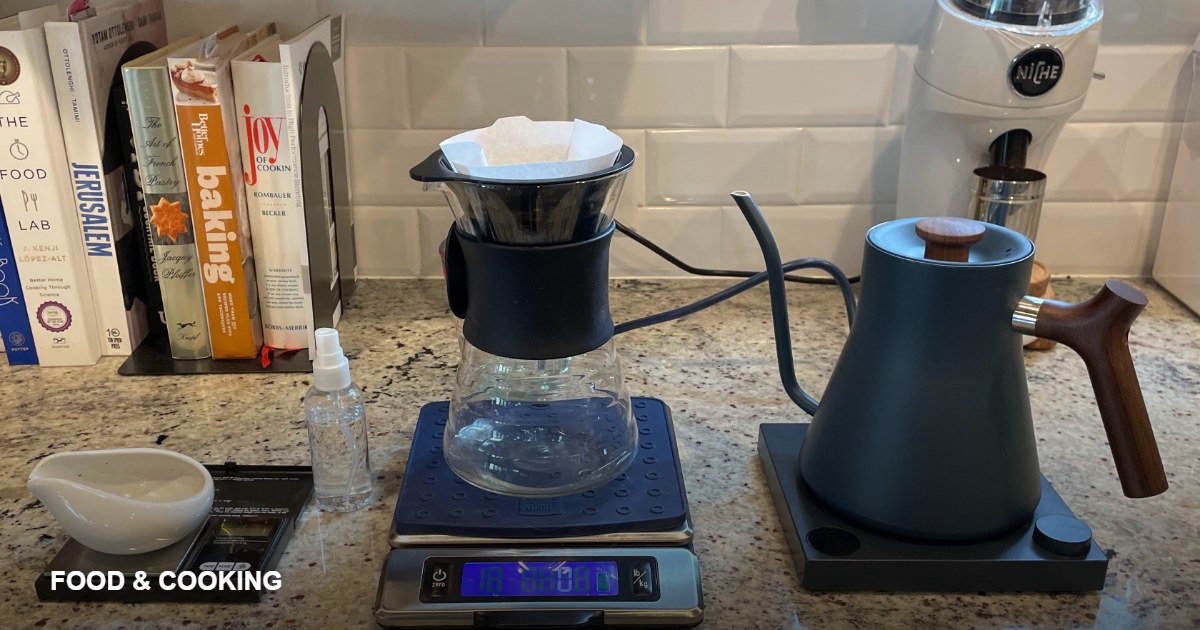
Good home coffee fails on scheduling more often than on technique — nobody wants a chemistry exam before caffeine. Here’s the pour-over morning engineered down to six calm minutes (the other methods compress similarly):
Table 3 — The six-minute pour-over morning
| Clock | Action | Why It’s There |
|---|---|---|
| 0:00 | Kettle on; scale, dripper, and filter out | Water heating is the long pole — start it first |
| 0:30 | Weigh 15 g beans, grind medium-fine | Grinding while water heats: the overlap that saves the morning |
| 1:30 | Rinse the paper filter with hot water; warm the mug | Removes paper taste; a cold mug steals 5°C from the brew |
| 2:00 | Grounds in; 50 g bloom pour; gentle swirl | The bloom releases CO₂ so water can actually reach the coffee |
| 2:45 | Remaining 200 g in slow spirals | Even saturation, no dry pockets |
| 4:30 | Drawdown finishes; dump the filter, rinse the dripper | Cleanup while it’s effortless — dried grounds are tomorrow’s chore |
| 6:00 | Drink | The entire point |
Two design notes: the workflow deliberately parallelizes (grinding during the heat-up, cleanup during the drawdown), and it ends with the gear already clean — the habit that keeps the ritual daily instead of occasional. The French press version is even simpler: everything steeps while you make toast, and the four-minute timer doubles as the toast’s.
7.Fixing the Three Bad Cups
Table 5 — The complete diagnostic chart
| The Cup Is… | Diagnosis | The Fix (change ONE thing) |
|---|---|---|
| Sour, sharp, thin | Under-extracted | Grind finer / brew longer / hotter water |
| Bitter, harsh, dry | Over-extracted | Grind coarser / shorten the time / slightly cooler water |
| Weak, watery | Ratio, not extraction | More coffee per cup (strength ≠ extraction) |
| Heavy, muddy | Too much coffee | Less coffee per cup |
| Stale, flat, cardboard | Old beans or pre-ground | Fresh beans, ground at brewing time |
| Salty or metallic | Water quality | Filtered water; very hard or distilled water both brew badly |
The row worth memorizing: sour means under-extracted, bitter means over-extracted. Two words, and ninety percent of all bad home coffee is diagnosed. The strength row is the runner-up insight — a weak cup is fixed with more coffee, not a finer grind, which would only make it weak and bitter.
8.The Upgrade Path (In Order of Impact)
- A burr grinder — the biggest cup improvement per dollar in all of coffee. (From $30 hand grinders upward.)
- Fresh, roasted-dated beans — buy bags with a roast date, not a best-before date; use within a month of roasting.
- A gram scale — the same scale discipline from our bread guide applies here: 15 g measured beats “two scoops” guessed.
- A kettle with temperature control — the dial for light versus dark roasts; until then, 30 seconds off the boil lands close enough.
- The pour-over dripper itself — last, cheapest, and only after the first four are in place.
Notice what the list does to the industry’s pricing logic: the expensive machine is last, and the grinder — sold as an afterthought — is first. That ordering alone, taken seriously, improves a household’s coffee more than any single appliance purchase ever made.
9.Beyond Black: Milk, Iced, and the Summer Switch
Two extensions round out the home barista’s range. Milk drinks without a machine: moka pot coffee plus milk heated and frothed — a $10 hand frother or a vigorously shaken warm jar — produces a genuinely satisfying flat-white-adjacent drink. The moka pot’s intensity exists precisely to stand up to milk; a pour-over’s delicacy drowns in it. Iced coffee done right: the amateur method (hot coffee poured over ice) brews a full cup and dilutes it into sadness; the brewer’s method — Japanese-style iced coffee — brews a stronger pour-over directly onto ice, so the ice is the rest of the water. Ratio: 20 g coffee, 150 g hot water for the bloom and pours, 100 g of ice waiting in the carafe. The result is bright, undiluted, and instantly cold — the summer cup that hot-brew-over-ice always promised and never delivered.
10.Frequently Asked Questions
Which single method should a total beginner buy first?
The AeroPress — nearly unbreakable, nearly un-mess-up-able, and the best traveler. If ritual and clarity appeal more than speed and durability, the pour-over. The French press if you brew for two and love a heavy cup. You cannot choose wrong at these prices; you can only choose first.
How often should I clean the grinder and brewer?
More often than instinct suggests — coffee oils go rancid and taint fresh brews within weeks. A monthly brush-out of the grinder and a weekly hot-water rinse of any brewer keep the equipment neutral; a quarterly descale of the kettle (citric acid or vinegar, boiled and rinsed) keeps temperatures honest. Five minutes monthly, and every variable you’ve calibrated stays true.
Is a more expensive burr grinder worth it?
Up to a point: the jump from blade to any burr grinder is enormous; from a good hand grinder to a $200 electric is incremental; beyond that, you’re buying espresso-grade precision this guide’s methods don’t require. Spend the difference on beans.
Is the moka pot the same as espresso?
No — it’s concentrated stovetop coffee at roughly one to two bars of pressure, versus espresso’s nine. Different drink, overlapping pleasures: the moka pot delivers intensity and crema-free punch for a thirtieth of an espresso machine’s price and none of its maintenance.
How should I store beans?
Airtight, opaque, room temperature, away from the stove — and buy weekly-sized quantities rather than monthly bags. The freezer debate is settled for most households: freezing a large batch in sealed weekly portions works fine; the daily in-and-out of one big bag does not.
Do I really need to weigh water?
Only if you want the same good cup twice. “A mug of water” varies by mug and by mood; 250 g is 250 g forever. The scale is what turns a lucky morning into a repeatable one.
What water should I use?
Filtered tap water is the sweet spot for most homes. Very hard water scales equipment and flattens flavor; distilled water under-extracts (minerals help pull flavor from the grounds). If your tap water tastes good in a glass, it brews good coffee — the simplest test in this entire guide.
Why does café coffee still taste different?
Mostly water, freshness, and calibration — cafés filter their water, burn through fresh beans daily, and dial in each morning. All three are available in your kitchen for less than a week’s café budget, which is the entire thesis of this guide.
Sources & Further Reading
Brewing baselines: the National Coffee Association’s How to Brew Coffee and roast guide; method background: Wikipedia’s brewed coffee overview. All links verified live at publication. Fresh bread for that fresh coffee: our beginner’s bread guide.
The perfect home cup isn’t a product; it’s four variables, a burr grinder, and ten mornings of one-change-at-a-time. Start tomorrow: weigh the coffee, time the brew, taste like you mean it. By next week, the café becomes optional — and the kitchen becomes the best coffee shop you know. And the daily dividend compounds quietly: a better cup every morning, a small ritual you control completely, and — not insignificantly — the café line item shrinking to an occasional pleasure rather than a daily tax.