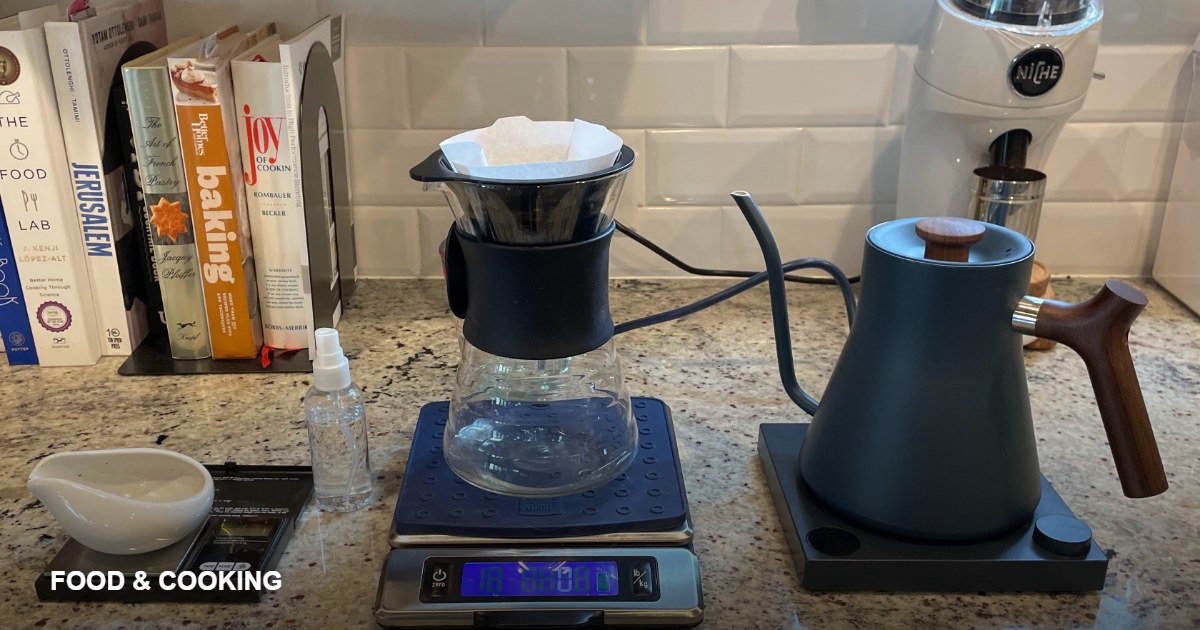
The best coffee method is the one you will still use on a rushed Wednesday. A V60 gives control, a French press gives body, a drip machine handles a crowd, an AeroPress travels well, and cold brew waits in the fridge. Start with a repeatable ratio, then change one variable at a time.
Before the brewer: water, beans, scale
Use fresh water that tastes good on its own. Weigh coffee and water; a “scoop” changes with bean size and the person holding it. Start near 60 g of coffee per litre of water—15 g for a 250 g mug—then adjust. Grind immediately before brewing when possible.
How to diagnose the cup
- Sour, thin, quick finish: extraction may be low. Grind finer, brew longer, or use hotter water.
- Bitter, dry, hollow: extraction may be too high. Grind coarser or shorten contact.
- Strong but sour: use less coffee only after improving extraction.
- Weak but bitter: use more coffee and a coarser grind.
Roast, water, temperature, agitation, and freshness also matter, so change one thing and keep notes.
Pour-over: 15 g coffee, 250 g water
Use a medium-fine grind and water around 200°F/93°C as a starting point. Rinse the paper. Wet the grounds with about 40 g of water for 30–45 seconds, then pour slowly in pulses until the scale reaches 250 g. Aim for a total brew near 2½–3½ minutes. If it drains far outside that range, adjust grind before reinventing the whole recipe.
French press: 30 g coffee, 500 g water
Use a medium-coarse grind. Add water, stir enough to wet every ground, cover, and steep for four minutes. Break the crust, skim loose foam if you like, then press slowly. Pour the entire brew out; coffee left with the grounds keeps extracting.
Drip machine: control what you can
Start with 60 g per litre, rinse removable parts, and descale on the manufacturer’s schedule. If the machine cannot wet the bed evenly or reach an appropriate brew temperature, technique has limits. For a half pot, test whether the brewer performs consistently at that volume.
AeroPress: a forgiving travel cup
Try 15 g medium-fine coffee and 230 g water. Stir, steep for 60–90 seconds, insert the plunger, and press gently. A hard press compacts the bed and makes the last centimetre needlessly difficult. Treat this as a baseline; the brewer rewards experimentation.
Cold brew: make concentrate deliberately
Combine 100 g coarse coffee with 600 g cold or room-temperature water. Steep covered for 12–16 hours, filter thoroughly, then dilute to taste. Cold brewing can taste less bitter or sour depending on the coffee and recipe, but “cold brew is always sweeter and less acidic” is too simple. Serving temperature, strength, roast, and filtration all change perception.
Keep a three-line brew note
Record coffee, grind setting, ratio, time, and one taste observation. “V60, setting 18, 15:250, 3:10, dry finish” gives your next brew a direction. “Not good” does not.
Good coffee deserves food with equal clarity. Our one-pan guide now contains twelve recipes with quantities and timings.

Sophie Bennett is the Food & Cooking Editor at The Adlroom Journal, writing home-cooking guides that explain the technique behind a recipe, from bread baking to weeknight one-pan meals.