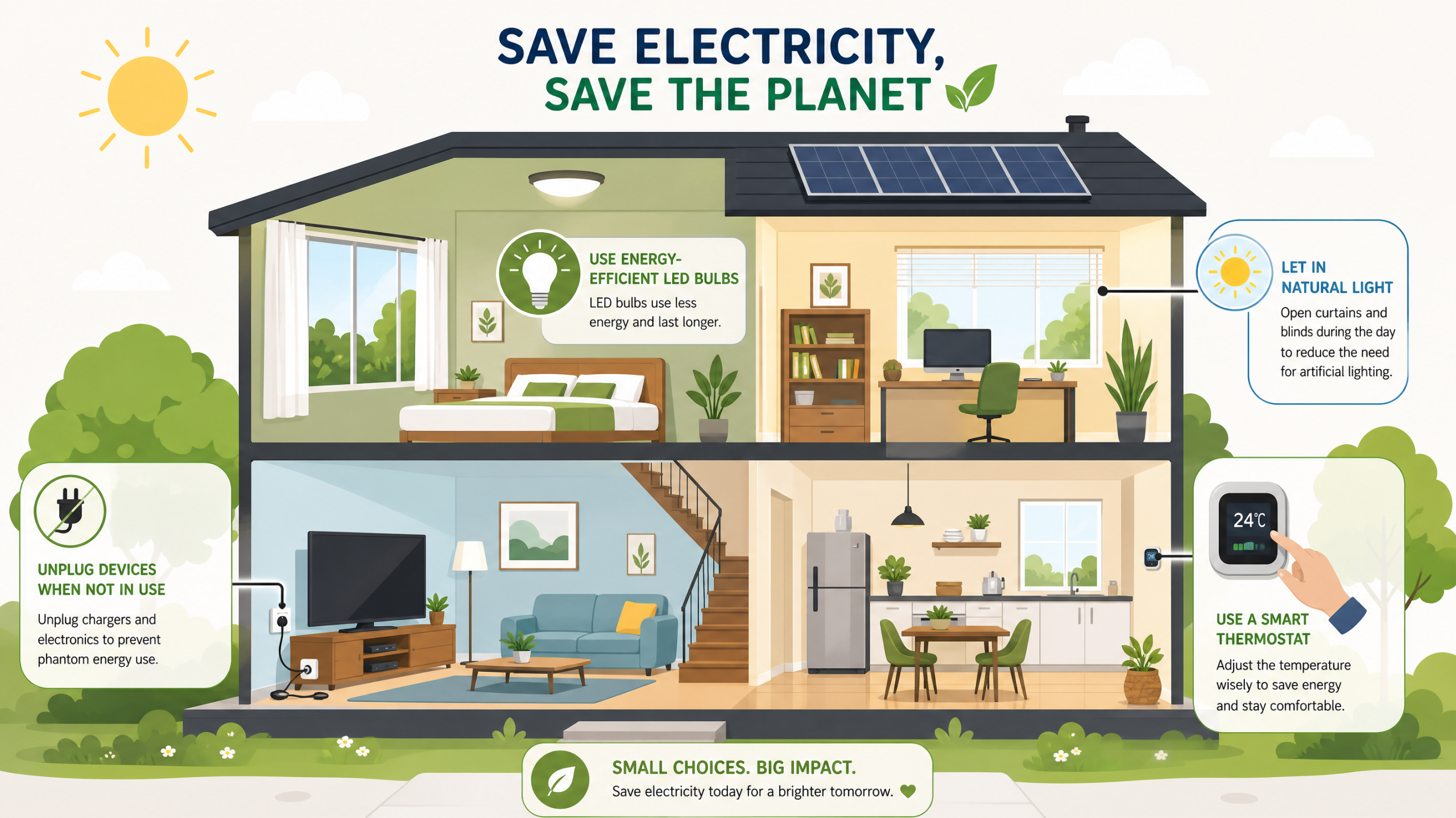
A quick framing note. Energy savings are highly variable based on climate, home age, household size, electricity rates, and current habits. The dollar figures quoted in this article come from the Department of Energy (DOE) and ENERGY STAR’s published averages — meaning they’re rough averages for a U.S. household. Your savings could be more or less. The point is the direction, not the exact dollar amount.
Step Zero: Know Where Your Bill Is Actually Going
Before changing anything, take five minutes to look at where your electricity is being used. According to the Department of Energy’s guidance on reducing electricity use, the national average electricity consumption is about 1,000 kWh per month — if your bill shows significantly more than that, there are likely larger savings available.
For a typical home, electricity use breaks down roughly like this:
Notice where the leverage is: heating and cooling alone is roughly half the bill. Saving 10% on lighting saves you maybe $5 a month. Saving 10% on heating/cooling saves you $40+. Prioritize accordingly. The rest of this guide is ordered by how much savings each change typically produces.
Heating and Cooling: The Big Lever
According to ENERGY STAR, almost half the annual energy bill for the average American household — over $900 a year — goes to heating and cooling. Even modest improvements here outweigh aggressive changes anywhere else.
Adjust the Thermostat
The single highest-leverage change in most homes is using less heating and cooling. The Department of Energy’s general guidance: the smaller the difference between indoor and outdoor temperature, the lower your bill. Every degree closer to outdoor temperature meaningfully reduces costs.
Practical targets most households can adapt to:
Winter: 68°F when you’re home and active, lower when sleeping or away.
Summer: 78°F when home, higher when away.
These aren’t strict numbers — comfort matters and varies by person. But the typical thermostat is set 3–5 degrees more aggressively than necessary, and adjusting toward these targets, even partway, captures real savings. A degree or two of conscious tolerance, especially when you’re not home, is worth dozens of dollars a month.
Get a Programmable or Smart Thermostat
According to ENERGY STAR, an ENERGY STAR certified smart thermostat can reduce heating and cooling bills by more than 8% — about $50 a year on average for the typical household. For homes that are unoccupied much of the day, the savings can reach about $100 a year. Even a non-smart programmable thermostat captures most of this savings if you actually program it.
The reason: heating or cooling an empty house wastes money continuously. A thermostat that automatically sets back when you’re at work and overnight while you’re sleeping, and brings the house back to comfort just before you wake or return, gives you the comfortable temperature you actually use without paying for the hours you don’t.
Seal Air Leaks
Air leaks are the silent budget killer in older homes. The DOE notes that up to a third of a typical home’s heat loss occurs through windows and doors, and gaps around outlets, baseboards, attic hatches, and plumbing penetrations add to it.
The two cheapest fixes that produce real savings:
Caulking gaps and cracks. A tube of caulk costs a few dollars. Sealing visible gaps around window frames, baseboards, and outlets reduces leakage substantially. The DOE estimates caulking leaks can save an average household 10–20% on heating and cooling bills.
Weather-stripping doors and windows. Self-adhesive foam or rubber weather-stripping costs $10–20 per door and seals the gaps around the frame. The DOE estimates this can save an additional 5–10% on heating and cooling bills.
If you’re not sure where leaks are: on a windy or cold day, slowly move a lit incense stick or a feather around door and window frames, outlets, and baseboards. Air movement reveals the leak. Renters can usually do basic weather-stripping without lease issues, and the materials peel off cleanly when moving out.
Use Window Coverings Strategically
From the DOE’s spring and summer energy-saving tips: window coverings prevent heat gain through windows during warm weather. In summer, close blinds and curtains on sun-facing windows during the hottest part of the day. In winter, do the opposite — open them during daylight hours to capture free solar heat, and close them at night to slow heat loss.
This is genuinely free. The blinds and curtains you already own are an underused energy tool when used with intention.
Maintain Your HVAC
A dirty air filter forces your heating or cooling system to work harder, consuming more electricity for the same comfort level. Replace HVAC filters every 1–3 months depending on use. Clean condenser coils on air conditioners. Have the system serviced annually. None of this is dramatic, but a poorly maintained HVAC system can use 15% or more energy than a maintained one.
Water Heating: The Underrated Cost
Water heating typically consumes about 18% of a home’s energy. According to the DOE, the Consumer Product Safety Commission recommends setting water heaters at no more than 120°F to prevent scalding — and many heaters come from the factory set to 140°F, far hotter than necessary. Lowering it to 120°F is free, takes less than five minutes, and produces measurable savings.
How to do it: Find the thermostat dial on your water heater (gas or electric). Mark the current position with a pencil. Lower it to 120°F or the equivalent setting. Wait 24 hours and check that your hot water is still comfortable at the tap.
Wash laundry with cold water. ENERGY STAR notes that hot water heating accounts for about 90% of the energy your washing machine uses to wash clothes — only 10% goes to the actual motor. Modern detergents are formulated for cold water and clean effectively for most loads. Switching to cold water laundry alone can save more than $40 a year for many households.
Wash full loads. ENERGY STAR estimates that washing full loads can save more than 3,400 gallons of water per year compared with partial loads — and the energy required to heat that water.
Shorter showers + low-flow showerhead. Replacing an old showerhead with a 2.5 gallon-per-minute low-flow model can save up to $145 each year on electricity, per ENERGY STAR. A 10-minute shower with a low-flow head uses about 25 gallons; a typical bath uses 30+. Showers win, and shorter showers win more.
Dishwasher: full loads, air dry. Skip the heat-dry cycle. Run the dishwasher only when it’s full. Don’t pre-rinse — modern dishwashers handle scraped (not rinsed) dishes effectively, per ENERGY STAR’s specific guidance.
Vampire Loads: Free Money Most People Leave on the Table
“Vampire load” or “phantom load” is the electricity electronics use when they’re turned off but still plugged in. According to ENERGY STAR’s analysis citing Consumer Technology Association data, 3.4 billion consumer electronic devices consumed about 143 TWh of electricity in 2017 — representing about 10% of residential sector electricity consumption. A meaningful chunk of that is standby power consumption.
Common vampires: TVs in standby, set-top boxes (often huge culprits), gaming consoles in instant-on mode, sound bars, computer monitors, phone chargers left plugged in without phones, microwave clocks, coffee makers with displays.
The fix is cheap and easy. ENERGY STAR specifically recommends using a power strip as a central “turn off” point. Plug your entertainment center (TV, set-top box, console, sound bar, etc.) into one power strip. Plug your home office (computer, monitor, printer) into another. Switch them off at the end of the day. Standby consumption goes to zero.
An “advanced power strip” or “smart power strip” automates this — it senses when the main device is off and cuts power to peripherals. Costs about $20 and pays for itself within months in most households. The DOE’s guidance on reducing electricity costs explicitly recommends advanced power strips to reduce vampire loads.
Check your 3 a.m. consumption. If your utility has a smart meter and online dashboard, look at your hourly use overnight when ideally nothing should be running but the fridge. If 3 a.m. consumption is significant, you have vampire loads worth hunting down. The DOE specifically recommends this diagnostic technique.
Lighting: Small Savings, Almost Free to Capture
If your home still has incandescent or halogen bulbs anywhere, replace them. According to ENERGY STAR, replacing your five most frequently used light fixtures or the bulbs in them with ENERGY STAR certified LED lights can save about $40 a year in energy costs. ENERGY STAR certified LED bulbs use up to 90% less energy and last 15 times longer than standard bulbs.
The math is unusually favorable. LED bulbs cost a few dollars each, last 10–25 years in typical use, and use a fraction of the electricity of older bulbs. Even at modest hours of daily use, an LED pays for itself in well under a year.
Beyond the bulbs themselves:
Turn off lights when leaving a room. Free.
Use natural light during the day. Free.
Outdoor lights on a timer or motion sensor. Outdoor lights left on all night are a steady drain. Timers and motion sensors keep them functional only when needed.
Lighting is a smaller share of the bill than heating/cooling, but the fixes are nearly free and produce immediate, measurable reductions in consumption.
Kitchen and Laundry Habits That Add Up
Refrigerator: Keep coils dust-free (vacuum behind/under the fridge once a year); don’t pack it so full that air can’t circulate; check the door seal closes tightly. If your fridge is more than 15 years old, an ENERGY STAR replacement can cut its specific energy use significantly — but only consider replacement if the old one is genuinely on its way out.
Microwave instead of oven for small heating jobs. A microwave uses far less energy than a full-size oven for warming small portions.
Clothes dryer: Clean the lint filter every load — not just for safety but for efficiency. A clogged filter makes the dryer work much harder. Don’t over-dry loads; many dryers have moisture sensors that should be used. Drying multiple loads back-to-back keeps the drum hot, reducing the energy to reheat between loads.
Air-dry when practical. A drying rack inside (or a clothesline outside, weather permitting) bypasses the dryer entirely. Not realistic for every load, but useful for towels, sheets, and clothes that don’t need fluffing.
Time-of-Use Rates: If Your Utility Offers Them
Many utilities now offer time-of-use (TOU) rate plans, where electricity costs more during peak hours (typically late afternoon/early evening) and less during off-peak hours (nights and weekends). The DOE notes that customers who can shift power use to off-peak times can save meaningfully — for example, running the dishwasher late in the evening instead of right after dinner.
Whether TOU rates make sense depends on your household’s habits. If you can easily shift dishwasher, laundry, EV charging, and pool pump use to off-peak hours, you can save 10–25% on bills under most TOU plans. If your peak-hour use is high and inflexible (working from home, evening cooking with electric stove), a standard flat rate may cost less.
Check with your utility about available rate plans. Most allow free switching with limited frequency, so you can experiment if curious.
A 30-Day Quick-Win Plan
Here’s a practical month-long sequence that captures most of the available savings without overwhelming you. Each week takes 30–60 minutes and stacks on the prior weeks.
Four Weeks to a Lower Bill
Week 1 — Thermostat & laundry. Adjust thermostat to 68°F winter / 78°F summer. Switch to cold-water laundry. Wash full loads only. Total cost: $0.
Week 2 — Vampire loads. Buy two power strips ($10–20). Plug entertainment center into one, home office into another. Switch off at end of each day. Lower water heater to 120°F. Total cost: $10–20.
Week 3 — Sealing & lighting. Buy weather-stripping for any drafty doors ($10–20). Replace top 5 incandescent bulbs with LEDs ($15–25). Caulk any visible gaps. Total cost: $25–50.
Week 4 — Smart thermostat (optional). If your home has a compatible HVAC system, buy and install an ENERGY STAR certified smart thermostat ($100–200). Set up schedules for occupied/unoccupied periods. Total cost: $100–200 (optional).
Total upfront cost: $35–270, depending on whether you do the smart thermostat. Expected annual savings: $200–500+ for most households, with most of it coming from the first three free or low-cost weeks. Payback period: usually under six months for the no-cost changes, under a year for everything.
Things Marketing Will Try to Sell You That Are Probably Not Worth It
“Power saver” devices. Small boxes that plug into outlets and claim to dramatically reduce your electricity bill are almost universally scams. The Federal Trade Commission has issued warnings about these products. They don’t work as advertised, and the testimonials are often fabricated. Save your $50.
Whole-house surge protectors marketed as energy savers. Surge protectors protect equipment from voltage spikes — useful. They don’t reduce electricity consumption. The marketing claims that conflate the two are misleading.
Expensive “smart” appliances when your current ones work. Replacing a functioning appliance to save a few dollars a month rarely pays back the purchase cost. The exception is genuinely old (15+ years) appliances near end of life — replacing those at end of life with ENERGY STAR models makes sense.
Premium HVAC filters. Mid-range pleated filters work fine for most homes. High-MERV filters can actually reduce HVAC efficiency in older systems that aren’t designed for them. Match the filter to the system’s specs, not to whatever’s marketed as premium.
Solar panels as a quick fix. Solar is a real and often good investment, but it’s a 15–30 year horizon decision with substantial upfront costs and considerations around roof angle, local rates, and incentives. It’s not “easy” and shouldn’t be evaluated alongside swapping light bulbs. Get the cheap wins first; consider solar as a separate, longer-term project.
Federal Rebates and Tax Credits
For larger upgrades — heat pumps, insulation, energy-efficient windows, electrical panel upgrades — federal tax credits and state rebates can substantially offset the upfront cost. The DOE’s Energy Savings Hub at energy.gov/save tracks current Home Energy Rebates and tax credits, which are managed by your state, territory, or Tribe.
For most readers of this article, the rebates aren’t the primary path — they’re relevant when you’re already planning a major upgrade. The thermostat, weatherstripping, LED bulbs, and power strips changes above produce most of the savings most households can capture without major investment. The rebates make sense if you’re already replacing a dying furnace, water heater, or HVAC system.
Worth checking what’s available in your area before any major home equipment purchase. Programs change frequently; the DOE Energy Savings Hub is the authoritative starting point.
Common Mistakes to Avoid
Trying to change everything at once. The four-week plan above works because it sequences changes rather than overwhelming you. Trying to overhaul every appliance, replace every bulb, and audit every outlet in a single weekend leads to incomplete projects and old habits resuming.
Focusing on small stuff while ignoring HVAC. Replacing every bulb in the house with LEDs saves real money but doesn’t approach what a thermostat adjustment does. Don’t optimize the 5% category before you’ve addressed the 50% category.
Setting the thermostat to extreme temperatures. 60°F in winter and 85°F in summer save money but make the house unpleasant enough that you’ll start using space heaters and fans extensively — which often consume more electricity than the central system you were trying to avoid. Comfort-tolerable settings (68°F / 78°F) are sustainable.
Buying things to “save energy” without checking the math. Any energy-saving product that costs hundreds of dollars and promises modest monthly savings needs payback-period analysis. If the payback is over 5 years, the product probably isn’t worth it. ENERGY STAR’s website lists actual estimated savings for most products — use the official figures rather than marketing claims.
Ignoring the utility’s own programs. Many utilities offer free home energy audits, rebates on efficient equipment, and assistance programs for households with limited income. Call your utility or check their website before assuming you have to pay for everything. The audits in particular are often free and identify specific, customized opportunities you can’t find from a general article.
Expecting overnight changes in the bill. Most of these adjustments save energy continuously over months. A one-month bill might not reflect changes dramatically because of weather variation. Compare year-over-year for the same season to see real effects — a colder winter naturally costs more even with efficiency improvements.
Small Changes, Real Compounding Savings
The energy industry would love to sell you a $5,000 solution to a problem that mostly responds to $50 of effort. The truth is that most households waste enough electricity through thermostat habits, vampire loads, hot-water defaults, and air leaks that fixing those four things alone produces savings comparable to what major appliance upgrades produce — at a fraction of the cost.
The lever order matters. Heating and cooling first, water heating second, electronics and lighting third, appliance upgrades last (and only when something is genuinely dying). Two degrees on the thermostat and a power strip on the entertainment center will outperform a fancy new toaster every time.
Pick three changes from this article this week. Adjust the thermostat, switch to cold-water laundry, and put your TV setup on a power strip. The combined annual savings from those three free or near-free moves typically exceeds $200. That’s a worthwhile return on a single afternoon of effort, repeating itself every year you keep the habit.
This article is for general informational and educational purposes only. Energy savings vary significantly by climate, home characteristics, household habits, electricity rates, and equipment age. Consult ENERGY STAR (energystar.gov), the Department of Energy’s Energy Saver website (energy.gov/energysaver), and your local utility for guidance specific to your situation, and consult a licensed professional for major electrical, HVAC, or plumbing modifications.
Leave a Reply