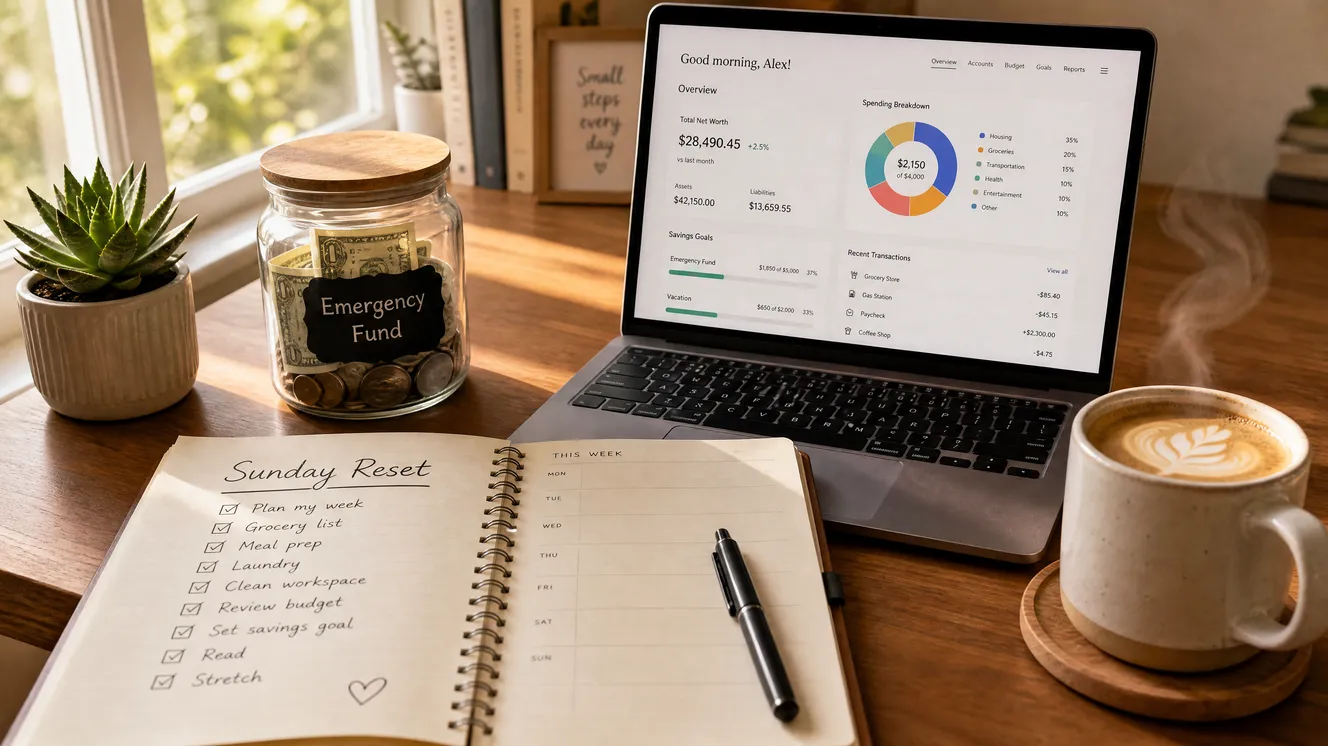
If you have ever looked at your bank balance after an unexpected bill and felt that quiet panic, you already understand why this matters. An emergency fund is not a luxury for people who already have money. It is the foundation that makes every other financial goal possible. Without it, a single car repair or medical bill can wipe out months of progress on debt payoff, retirement contributions, or saving for a home. With it, the same event becomes a line item rather than a crisis.
The framework below is built around how real people actually save, not how spreadsheets imagine they save. It assumes you may be starting from zero, that your income may not be perfectly stable, and that you have competing priorities like debt payments or rent. Each step is designed to work even under those constraints.
Step 1: Set a Realistic Starter Goal (Not Six Months of Expenses)
The standard advice is to save three to six months of living expenses. That advice is correct in the long run, but it is the wrong place to begin. If you are starting from zero, a six-month target looks like a wall. You stare at it, feel defeated, and never start. The fix is to set a much smaller first milestone that you can actually reach in a few months.
The Consumer Financial Protection Bureau’s essential guide to building an emergency fund emphasizes that a savings of any size provides real financial security, and that setting a specific, achievable goal is one of the key principles of building a savings habit. Even a small cushion changes your behavior because it changes what you fear.
A practical starter goal for most households is $500 to $1,000. That amount is large enough to absorb the most common real-world emergencies: a car battery, a minor medical copay, a flight home for a family situation, an appliance repair. It is also small enough that a household saving $50 to $100 a month can reach it within a year, and a household that can save more will get there faster. Once you hit that starter goal, you raise the target to one month of essential expenses, then three months, then six.
The Three Milestones
Milestone 1 — Starter Fund: $500 to $1,000. Covers most one-off shocks. Reachable in 3 to 12 months for most households.
Milestone 2 — One Month: One month of essential expenses (rent, food, utilities, insurance, minimum debt payments). Protects against a single missed paycheck.
Milestone 3 — Full Fund: Three to six months of essential expenses. The long-term target recommended by most financial planners.
Step 2: Calculate Your Actual Number, Not a Generic One
Once you know your starter goal, calculate what your full fund should eventually look like. The number depends on your situation, not on a one-size-fits-all rule. Bankrate’s guide to starting an emergency fund notes that an unstable income, high insurance deductibles, self-employment, or supporting dependents are all reasons to lean toward the higher end of the three-to-six-month range. A household with two stable incomes, low fixed costs, and no dependents can sit comfortably toward the lower end.
To find your number, list your essential monthly expenses: rent or mortgage, utilities, groceries, transportation, insurance premiums, minimum debt payments, and any other costs you cannot stop paying without consequences. Streaming services, dining out, and discretionary shopping do not belong on this list because, in a true emergency, you would cut them. Add up the essentials, then multiply by three for a minimum target and by six for a comfortable one.
For example, if your essential monthly expenses come to $3,200, your full emergency fund range is $9,600 to $19,200. That is a big number, which is exactly why you start with the $500 milestone and work up. The full target is a destination, not a starting line.
Step 3: Open a Separate, Insured High-Yield Savings Account
Where you keep your emergency fund matters almost as much as having one. The right account does three things at once: it keeps your money safe through federal deposit insurance, it pays meaningful interest, and it adds enough friction that you will not tap it for non-emergencies. A regular checking account fails the third test. A brokerage account fails the first.
The standard recommendation is a high-yield savings account at an FDIC-insured bank or NCUA-insured credit union. The FDIC’s consumer guidance on saving for the unexpected notes that automatic transfers into a savings account on a set schedule help you save money before you spend it. Online banks generally offer the highest rates because they have lower overhead than brick-and-mortar institutions, and Bankrate’s tracker of high-yield savings rates shows top accounts paying multiple times the national average.
When choosing the account, prioritize four features in this order: federal deposit insurance, no monthly maintenance fees, a competitive Annual Percentage Yield, and easy electronic transfer to your primary checking account. Marketing bonuses, app design, and brand recognition are secondary. What you are buying is a boring, safe place to park money you hope to never use.
Critically, this account should not be at the same bank as your checking account, or at minimum should be a clearly separate account with no debit card and no easy in-app transfers. Friction is a feature here, not a bug. The two or three business days it takes to move money to your checking account is enough time to ask yourself whether what you are about to spend on is actually an emergency.
Step 4: Automate Everything You Possibly Can
Willpower is the worst possible foundation for a savings habit. It runs out, gets renegotiated when you are tired, and disappears entirely when something exciting goes on sale. Automation is the foundation that actually works. The principle is simple: the money should move to savings before you ever see it in your checking account.
There are two main ways to automate. The first is a split direct deposit through your employer, where a fixed amount of each paycheck is routed straight to your savings account and the rest goes to checking. The second is a recurring automatic transfer scheduled for the day after each payday, which moves a fixed amount from checking to savings before you can spend it. Both work. The split deposit is slightly stronger because the money never lands in checking at all, but the recurring transfer is easier to adjust and is available to anyone with online banking.
Start with an amount that feels almost too small to matter. Five or ten dollars per paycheck is fine. The point of the first month is not to save a lot of money; it is to prove to yourself that the system works and that you do not actually miss the money. Once that is established, you raise the amount every one to three months until it is at the upper edge of what you can sustain.
Step 5: Find the Money — Six Practical Sources
If your budget is tight, the next question is where the money to save will actually come from. According to Bankrate’s reporting, 54% of Americans are saving less for emergencies because of inflation and rising prices, so the pressure is real. But there are repeatable sources of cash that most households can tap, even on a constrained budget.
The tax refund is especially important because for many households it is the single largest deposit of the year. The Consumer Financial Protection Bureau’s research shows that automatic, lump-sum saving from tax refunds is one of the most effective ways to jump-start an emergency fund, particularly for people with limited monthly capacity to save.
Step 6: Decide What Counts as an Emergency
An emergency fund only works if you do not spend it on non-emergencies. The category creep is the silent killer. A planned holiday becomes “an emergency” because you forgot to budget for it. A sale on a laptop becomes “an emergency” because the deal expires tomorrow. The fund slowly drains while never being touched for a real shock, and then a real shock arrives and the cushion is gone.
Define the rules in advance, while you are calm. A useful working definition: an emergency is something that is unexpected, urgent, and necessary. All three conditions must be true. A flat tire is unexpected, urgent, and necessary. A new phone because the old one is slow is none of those. A medical bill from a procedure you knew about three months ago is necessary but neither unexpected nor truly urgent — it should have been budgeted for.
Emergency vs. Not an Emergency
Emergency: Job loss, urgent medical bill, essential car repair, broken water heater or furnace, emergency travel for a family situation, critical home repair like a roof leak.
Not an emergency: Holiday gifts, vacations, annual insurance renewals, “once-in-a-lifetime” sales, social events, electronics upgrades, planned dental work, weddings you have known about for months.
The non-emergencies on the right are real expenses and deserve to be planned for, but they belong in separate sinking funds or budget categories, not in your emergency fund. Mixing them defeats the purpose.
Step 7: Balance Emergency Savings With High-Interest Debt
One of the most common questions for anyone starting from scratch is whether to save for emergencies first or pay down credit card debt first. The honest answer is that you usually do both, in a specific order. Bankrate’s report found that 29% of Americans have more credit card debt than emergency savings, and 31% are now prioritizing both at the same time. Bankrate analyst Stephen Kates recommends focusing on the single most important financial priority and making consistent progress there first rather than splitting attention thinly.
A practical sequence that works for most people: first, build a small starter cushion of $500 to $1,000 so a minor surprise does not push you deeper into debt. Second, focus aggressively on high-interest debt, usually anything above roughly 8% to 10%, while making only the minimum payment on the emergency fund. Third, once the high-interest debt is gone, redirect those payments to building the fund up to its full three-to-six-month target.
This order matters because a credit card charging 22% interest is destroying more wealth than a savings account earning 4% is creating. But going debt-free with zero emergency cushion just means the next surprise puts you right back on the card. The small starter buffer breaks that cycle.
Common Mistakes That Quietly Sink Emergency Funds
Even with a good system, a few specific mistakes show up again and again. Knowing them in advance makes them easier to avoid.
Keeping the fund in your checking account. If you can see the balance and tap it with your debit card, you will spend it. Separation is non-negotiable.
Investing the fund in stocks for “better returns.” An emergency fund is not an investment; it is insurance. The whole point is that the money is there in full when you need it. Putting it in the stock market means you might need to sell during a downturn, locking in a loss exactly when you can least afford one.
Stopping contributions once the fund is “done.” The fund needs to keep pace with your life. If your rent rises 8% next year, your fund needs to grow proportionally. Review the target at least once a year and after any major life change like a move, a new dependent, or a job change.
Not replenishing after a withdrawal. The FDIC’s guidance on starting small to build big savings specifically recommends developing a plan to replenish any withdrawals from your emergency fund. After a legitimate emergency, the automation that built the fund should rebuild it. A withdrawal is not a failure; an unrefilled fund is.
Lifestyle inflation eating new income. When your income rises, the temptation is to expand spending to match. Instead, route a fixed percentage of every raise to savings before adjusting your lifestyle. A 5% raise that splits 50/50 between savings and spending still feels like a raise but builds the fund much faster.
A 12-Month Plan to Build Your First $1,000
To make all of this concrete, here is what a realistic first year looks like for someone starting from zero with a modest income.
Month-by-Month Roadmap
Month 1: Open a high-yield savings account at an FDIC-insured online bank. Set up an automatic transfer of $25 per paycheck. Cancel one unused subscription.
Months 2–3: Confirm the transfers are running. Increase contribution to $40 per paycheck if comfortable. Sell one or two unused items and deposit the proceeds.
Months 4–6: Direct any tax refund, bonus, or cash gift into the account. Aim to be at $400–$600 by month six.
Months 7–9: Increase contributions again if income allows. Audit subscriptions a second time. Goal: $700–$850.
Months 10–12: Hit $1,000. Celebrate briefly, then raise the target to one full month of essential expenses and keep the automation running.
Why This Matters Beyond the Money
The financial case for an emergency fund is obvious, but the psychological case is at least as important. Bankrate’s research shows that 60% of Americans are uncomfortable with their level of emergency savings, and 43% would be “very worried” about covering immediate living expenses if they lost their primary income source tomorrow. That worry is not abstract. It shows up as worse sleep, higher stress, more conflict in relationships, and worse decisions about everything from job offers to housing to healthcare.
An emergency fund does not eliminate uncertainty. Life will continue to deliver surprises regardless of what is in your savings account. What the fund does is change your relationship to those surprises. A flat tire becomes annoying instead of catastrophic. A short gap between jobs becomes a transition instead of a crisis. A medical bill becomes a payment instead of a debt spiral.
The St. Louis Fed’s analysis of household financial preparedness draws on the Federal Reserve’s 2024 Survey of Household Economics and Decisionmaking, which found that 63% of adults could cover an unexpected $400 expense using cash, savings, or a credit card paid off in full on the next statement. That leaves a substantial share of households who cannot, and the difference between those two groups is rarely income alone — it is whether a system is in place.
Start This Week, Not Next Year
Building an emergency fund from scratch is one of the few personal finance moves where the start matters far more than the strategy. The household that opens a separate high-yield savings account this week and automates a $25 transfer will be vastly further ahead in a year than the household that waits to design the perfect plan. The compounding here is not just financial; it is behavioral. Every automated deposit makes the next one easier.
Pick a starter goal between $500 and $1,000. Open the account today. Schedule the transfer for the day after your next paycheck. Define what counts as an emergency before you ever touch the money. Then keep going until you have one month of expenses saved, then three, then six.
An emergency fund will not make you wealthy. It will do something more important: it will make every other financial decision in your life less stressful, less reactive, and more deliberate. That is worth starting today.
This article is for informational purposes only and does not constitute financial advice. For decisions specific to your situation, consider speaking with a qualified financial professional.
Leave a Reply