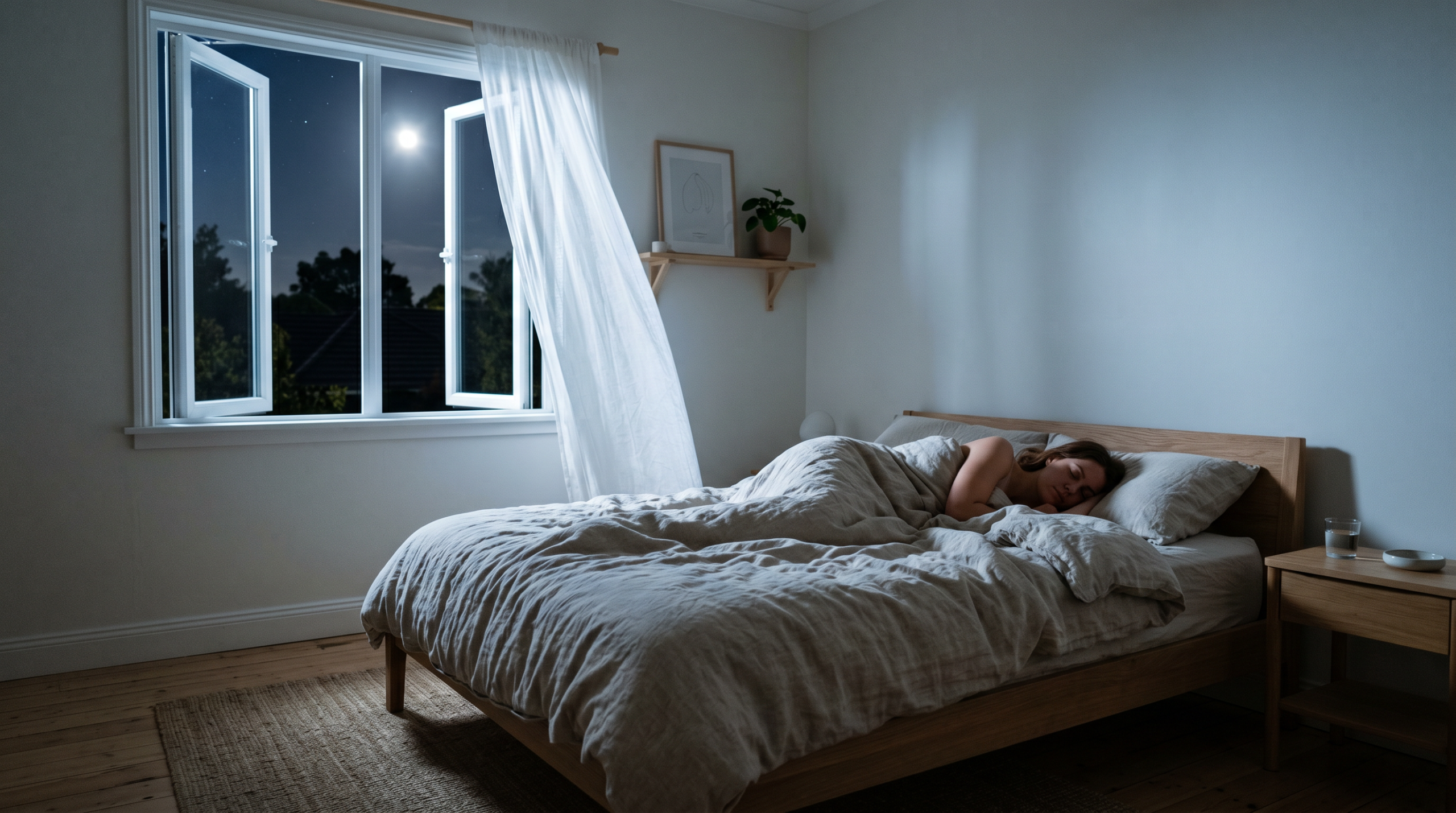
A quick framing note. Bad sleep can sometimes be caused by an actual medical condition — sleep apnea, restless legs, severe insomnia, anxiety disorders, thyroid problems. If you’ve genuinely tried the basics and still sleep poorly for weeks at a time, that’s a doctor conversation, not a blog-article one. This guide is for the much larger group of people whose sleep is mediocre because of habits and environment, not because of medical issues.
The Single Most Important Habit
If you do nothing else in this article, do this: pick a wake time, and use it every day, including weekends. Your body’s circadian rhythm — the internal clock controlling sleep hormones, temperature, energy, and alertness — depends on consistent signals. The National Heart, Lung, and Blood Institute’s explanation of the sleep-wake cycle emphasizes that your central circadian clock takes its cues from the environment, especially light, darkness, eating, and physical activity. Random wake times confuse this system. Consistent ones let it stabilize.
This sounds easy and isn’t. The hardest part is the weekend. Sleeping until noon on Saturday after waking at 7 a.m. all week creates what sleep researchers call “social jet lag” — your body experiences the same disruption as flying across several time zones. By Sunday night you can’t fall asleep, by Monday morning you can’t wake up, and the week starts in a hole. Aim to keep weekend wake times within about an hour of weekday wake times. You can still sleep slightly longer, but try not to shift the clock dramatically.
Counterintuitively, consistent wake times matter more than consistent bedtimes. Bedtime tends to drift naturally based on your day; wake time is what you control with an alarm. Anchor the wake time first. The bedtime will follow if you’re tired enough.
Light Is the Strongest Signal
According to the NHLBI’s treatment recommendations for circadian rhythm disorders, light is the strongest signal in the environment for resetting your sleep-wake cycle. Most people need more sunlight during the day and less artificial light at night. Both halves of that sentence matter.
Get bright light in the morning. Within 30 minutes of waking, expose yourself to bright light — ideally sunlight. Even on overcast days, outdoor light is many times brighter than indoor light, and that morning brightness is the single strongest signal you can give your body that it’s time to be awake. Two minutes outside while drinking coffee, a walk around the block, sitting by a window — any of these works. People who live in dark winter climates or work indoors all day are at higher risk of circadian drift; for them, a few extra minutes of intentional light exposure in the morning is the most cost-free intervention available.
Dim the lights at night. The reverse principle holds in the evening. Bright overhead lights, especially with cool/blue spectrum bulbs, suppress melatonin production and tell your body it’s still daytime. An hour or two before bed, switch off overhead lights and use only warmer, dimmer sources — a single lamp on a low setting, candles, or the dimmest mode of nearby lights. Most modern phones, tablets, and computers have a “night mode” or “night shift” setting that reduces blue light automatically after sunset; enable it for free.
Make the bedroom truly dark. Streetlights through curtains, the LED on a smoke detector, a charging laptop’s status light — small bright points in an otherwise dark room can subtly disrupt sleep. If you can’t afford blackout curtains, even a folded towel jammed over the curtain rod, or tape over an indicator LED, blocks light at zero cost. You’re not aiming for perfection. You’re aiming for “darker than it was.”
Cool, Quiet, and Boring
The ideal bedroom is cool, quiet, dark, and used for almost nothing except sleep. The CDC specifically recommends keeping your bedroom quiet, relaxing, and at a cool temperature, plus turning off electronic devices at least 30 minutes before bedtime. Most sleep researchers recommend a bedroom temperature in the range of about 60–68°F (about 15–20°C); body temperature naturally drops during sleep, and a cool room supports that drop.
If your bedroom runs hot, you have free options before you start buying things. Crack a window. Use a thinner blanket. Take a warm (not hot) shower an hour before bed — counterintuitively, this helps you cool down faster afterward as blood vessels in your skin dilate. Sleep in lighter clothing, or none at all if you prefer. Run the bedroom fan you already own. None of this requires new purchases.
For noise, the cheapest white-noise generator is a fan you already own. For free apps and websites, search “white noise” or “brown noise” on any device — countless free options exist. Earplugs cost a few dollars at any pharmacy if you genuinely need silence and live somewhere noisy. None of this requires a $200 sound machine.
Finally — and this matters more than people think — keep your bedroom for sleep. If you also work, eat, watch shows, and scroll on your phone in bed, your brain stops associating the bedroom with sleep. Over time, you may find it harder to fall asleep in the place where you’ve spent the most awake time. Working from another room or even a different chair, and only using the bed for sleep and intimacy, gradually re-trains the association. This costs nothing.
A Quick Reference Table
Caffeine: It Lasts Longer Than You Think
Caffeine has a half-life of roughly 5–6 hours for most adults — meaning half of the caffeine in your 3 p.m. coffee is still active in your system at 9 p.m. For slow metabolizers (a meaningful share of the population due to genetic variants), the half-life can stretch to 8+ hours. This is why people who insist they “can drink coffee right before bed” often still have measurably worse sleep architecture even when they fall asleep fine — the caffeine is interfering with deep sleep, not with sleep onset.
The CDC’s own guidance recommends avoiding caffeine in the afternoon or evening. The practical rule that holds up for most adults: have your last caffeinated drink before 2 p.m. If you currently drink coffee at 4 or 5 p.m., shift it earlier and see what happens. Most people are surprised at how much their sleep improves.
Worth noting: caffeine isn’t just in coffee. Black tea, green tea, matcha, many sodas, energy drinks, pre-workout supplements, some chocolate, and certain over-the-counter medications all contain caffeine. If you’ve cut off coffee at 2 p.m. and still aren’t sleeping well, check whether something else in your afternoon routine is the actual culprit.
Alcohol Is Not a Sleep Aid
A drink or two in the evening makes most people drowsy. This feels like a sleep aid. It isn’t. Alcohol initially promotes sleep onset, but as your body metabolizes it through the night, it fragments sleep, suppresses REM, and causes early-morning awakenings — the classic 3 a.m. wake-up that won’t let you fall back asleep. The CDC explicitly recommends avoiding alcohol before bedtime, and the underlying reason is well-documented in sleep research.
If you drink, try to finish your last drink at least three hours before bed. Better yet, experiment with a few alcohol-free weeks and notice what happens to your sleep quality. Many people who haven’t slept well in years discover their drinking pattern is the main cause once they try a break.
This isn’t a moral judgment. Plenty of people drink moderately and sleep fine. But if you’re struggling with sleep and you’re also drinking in the evenings, alcohol is one of the highest-probability suspects — and removing it costs nothing.
A Pre-Sleep Wind-Down Routine
Sleep doesn’t happen on demand. Your nervous system needs a transition window between the day’s stimulation and sleep. CDC and NIOSH’s guidance on preparing for sleep recommends following a relaxing routine before bedtime to help your body make the transition from being awake to sleeping — keeping light levels low one to two hours before bedtime and using calming activities like washing your face, brushing your teeth, and changing into sleep clothes as transition cues.
A workable wind-down doesn’t have to be elaborate. Forty-five minutes is more than enough for most people. A simple example:
A 45-Minute Wind-Down
45 minutes before bed. Turn off bright overhead lights. Switch to one lamp. Stop drinking water (so you’re not waking up at 3 a.m. for the bathroom).
30 minutes before bed. Put down the phone. Brush teeth, wash face, change into sleep clothes. Set out clothes for tomorrow.
15 minutes before bed. Read a paper book, listen to calm music, do five minutes of slow breathing, or just sit quietly. Whatever lets your nervous system slow down.
Lights out. Get into bed and turn off the light. Don’t lie awake scrolling.
The point isn’t following any specific script. The point is having a repeatable sequence your body recognizes as “we’re shutting down now.” After a few weeks of consistent use, the routine itself becomes a sleep cue. You’ll start feeling drowsy partway through it.
When You Can’t Fall Asleep
Everyone occasionally has nights where sleep won’t come. The worst thing to do is lie in bed staring at the ceiling getting more frustrated. This trains your brain to associate the bed with anxiety rather than rest, and over weeks of bad nights, it can develop into actual insomnia.
The standard advice from sleep researchers — sometimes called stimulus control — is: if you’ve been in bed for about 20 minutes and you’re not asleep, get out of bed. Go to another room, keep the lights low, and do something calm and slightly boring until you feel sleepy again. Reading a paper book, folding laundry, doing a jigsaw puzzle. Then go back to bed.
Critically: don’t pick up the phone. Don’t turn on the TV. Don’t do anything stimulating or anything bright. The point is to remove yourself from the bed without triggering full wakefulness. Most people fall asleep faster the second time they try than they would have lying there frustrated.
If you wake up in the middle of the night and can’t get back to sleep, the same approach applies. Don’t lie there checking the time. Don’t grab your phone. Get up briefly, do something calm and dim, return to bed.
The Phone in Bed Problem
Almost everything in this guide is easier if your phone isn’t in the bedroom at all. The phone-in-bed pattern causes three distinct problems, each of which costs you sleep.
Scrolling delays sleep onset. The bright screen, the unpredictable content, and the way each swipe triggers a small dopamine response all push back the moment you actually fall asleep. People who scroll for “just a few minutes” before bed routinely lose 30–60 minutes of sleep without noticing.
Nighttime wake-checking. If you wake up briefly at 3 a.m. and your phone is right there, you’ll check the time. Maybe a notification. Maybe just one quick look. The light, the cognitive engagement, and the rumination triggered by whatever you read all make it dramatically harder to fall back asleep. Twenty minutes later you’re wide awake and frustrated.
Anxiety pile-up. Late-night phone use is the prime time for doomscrolling, work email checks, and social media spirals — all of which prime your nervous system for alertness rather than sleep. The content you encounter at 11 p.m. is the content your brain processes when it should be winding down.
The fix is the most consequential free intervention available: charge your phone outside the bedroom. Buy a cheap alarm clock for $10 if needed, or use a smart speaker as an alarm. The phone is in another room overnight. This single change resolves all three problems at once, and people who try it for two weeks rarely go back.
Daytime Habits That Affect Tonight’s Sleep
Sleep is shaped by what you do during the day, not just what you do at night.
Move your body. Even modest daily movement — a walk, some stretching, light exercise — meaningfully improves sleep quality. The benefits show up over weeks, not the first night, so don’t expect immediate results.
Don’t nap late. Short naps (20–30 minutes) before about 2 p.m. don’t disrupt nighttime sleep for most people. Long naps, or naps later in the afternoon, can. If you nap and find you can’t fall asleep at night, shortening or eliminating the nap is the easiest test.
Eat dinner with some time to spare. A heavy meal right before bed competes with sleep for your body’s resources — digestion ramps up just as you’re trying to wind down. Aim to finish dinner at least two hours before bed. The CDC’s guidance specifically recommends avoiding large meals before bedtime.
Manage stress before it reaches the pillow. Anxiety that hits you at 11 p.m. is much harder to deal with than anxiety you addressed at 6 p.m. If you tend to lie in bed running through tomorrow’s worries, try writing them down for ten minutes earlier in the evening — a “brain dump” of everything on your mind, plus what you’ll do about it. People who do this consistently often find their nighttime mind chatter quiets significantly.
Get outside, especially in winter. Even short outdoor exposure provides far more light than indoor lighting and helps regulate circadian rhythm. The 10-minute walk you don’t think you have time for is sometimes the most effective sleep intervention available.
Things People Spend Money On That Usually Don’t Help
Sleep trackers. Rings, watches, and mattress sensors that measure your sleep can be interesting for a couple of weeks. After that, for most people, they create more anxiety than information. Knowing you “slept poorly” before you’ve even gotten out of bed often turns into a self-fulfilling prophecy. A condition called orthosomnia — anxiety about sleep data — is now common enough that sleep specialists routinely tell patients to stop tracking. If you’re already sleeping reasonably well, a tracker won’t help. If you’re sleeping poorly, the data won’t fix the cause.
Expensive supplements. The supplement industry sells billions of dollars of “sleep aids” with limited evidence of benefit for most people who aren’t deficient. Melatonin can help in specific cases (jet lag, shift work) but is often used incorrectly. Magnesium may help some people, mostly those who are deficient. Most other sleep supplements have weak evidence at best. If you have a specific deficiency, get tested by a doctor and supplement what’s actually low. Otherwise, you’re paying for hope.
Expensive mattresses. A good mattress matters. A $4,000 mattress isn’t four times better than a $1,000 mattress, and a $1,000 mattress isn’t ten times better than a $300 one. Beyond a basic threshold of comfort and support, mattress price and sleep quality decouple sharply. If your current mattress is uncomfortable, replace it. If it’s fine, don’t.
Blue-light blocking glasses. The evidence that they meaningfully improve sleep is thin. The same effect — reducing evening blue light exposure — can be achieved for free by using your devices’ built-in night modes and dimming the lights in your home.
Sleep apps with subscriptions. Meditation and white-noise apps charge $50–$100 per year for content that’s available free on countless other apps and websites. If the app helps you, keep it. If you’re not using the paid features, cancel and use a free alternative.
When to Talk to a Doctor
The free approaches in this guide work for most people most of the time. But some sleep problems aren’t fixable with habit changes. According to NHLBI’s guidance on circadian rhythm disorders, disruptions in sleep patterns can be temporary and caused by habits, jobs, or travel — but when sleep-wake cycle disruption persistently interferes with daily activities, it may indicate a medical issue worth evaluating.
Signs worth bringing to a doctor:
Snoring loudly, gasping for air during sleep, or waking up unrefreshed despite seemingly adequate hours — possible sleep apnea, which is genuinely common and treatable. Persistent insomnia (more than three nights a week for more than three months). Excessive daytime sleepiness even after adequate sleep. Restless or uncomfortable sensations in the legs that disrupt sleep onset. Falling asleep involuntarily during the day.
If any of those describe you, no amount of sleep hygiene will substitute for proper evaluation. Sleep studies, sometimes done at home, can identify underlying conditions; many are highly treatable, and continuing to suffer without proper diagnosis is the actual cost.
The Basics Beat the Gadgets
Most people with sleep problems spend money before they spend habits. They buy the supplement, the tracker, the mattress, and the app, while still going to bed at random times, scrolling in bed, drinking coffee at 4 p.m., and having a glass of wine after dinner. None of the purchases will outperform fixing those underlying habits.
The good news is that the habit changes that matter are remarkably few. Wake at a consistent time. Get morning light. Avoid caffeine after early afternoon. Dim lights and put down screens an hour before bed. Keep the bedroom cool, dark, and quiet. Don’t use alcohol as a sleep aid. Get out of bed if you can’t sleep instead of stewing. Move your body during the day. That’s most of what works, and all of it is free.
Start with one change this week — the consistent wake time is the highest-leverage place to begin. Add another change in two weeks. After a month or two of small consistent changes, most people sleep noticeably better without having bought a single thing.
This article is for general informational and educational purposes only and does not constitute medical advice. Persistent sleep problems, suspected sleep disorders, or unexplained changes in sleep should be evaluated by a qualified healthcare provider.
Leave a Reply